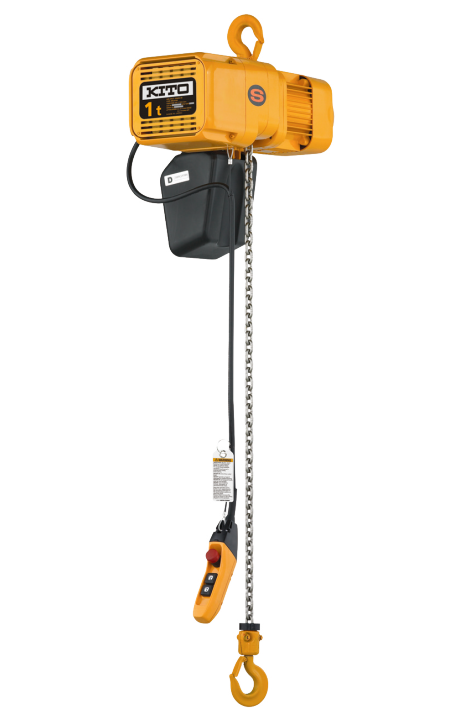
Kito Electric Hoists- The best quality on the market?

Kito ER2 Electric Chain HoistIf you work closely with lifting equipment and hoists you maybe aware of the Kito brand, having become more established in the UK market over the last few years Kito are well respected on a global scale for producing some of the most robust and technologically advanced hoists with favoured Japanese engineering.

The construction of Kito’s ER2 series of hoists is impeccable, offering as standard their aluminium die cast body designed with both strength and stability in mind while also remaining lightweight and tough, many hoist makers out there now are using plastic covers which will certainly not standup to the work that the Kito ER2 can. The Nickel-plated load chain offers an alternative to the traditional Zinc-plated version that many alternative brands offer, ideal for demanding environments.

A huge feature of the Kito ER2 is the thermal motor protection device which prevents the operator from using the hoist beyond its capability and burning out the motor (a common occurrence with poorly trained operators) A sensor in the hoist cuts the power to the motor in any case of overheating, when activated with a load suspended the load will remain securely braked in place while the motor cools down, once cool the operator can begin using the hoist again and safely lower or raise the load suspended, this feature can save you from having to replace the most expensive component in the hoist, a huge investment as standard!

Not only does the hoist protect the operator from burning out the motor (and having their boss to answer to when he has a broken hoist motor) but also protects the user from overloading the hoist, the Kito ER2 features a unique friction clutch developed by Kito as an overload protection which cuts the transmission power from the motor in the case of overload.

A feature that few other hoists offer (especially as standard) is Kito’s CH meter with integrated inverter which neatly displays the number of operation hours the hoist has encountered, ideal when it comes to servicing and especially in the case of warranty claims, this also helps control inspection and maintenance intervals and shows the true usage of the hoist. Standard upper and lower limit switches protect the operator from human error when controlling the hoist, limits can be set to prevent the hook from travelling too high or too low, these limits are extremely precise.

Why Crane & Lifting Gear Inspection Is Vital For Safety

With health and safety regulations getting tighter each and every day we are forced to pay attention to new legislation. It is essential by law that all cranes and above hook equipment is inspected by a qualified body every 12 months, with under the hook equipment requiring 6 monthly inspections (this is most likely because there is more chance that under the hook equipment gets damaged or worn out). With hoists or cranes in a more intense environment such as a nuclear facility or wet room it is recommended by experts that equipment be inspected every 3 months by a qualified body and of course a visual inspection by the operator before each use as standard.

Preventative maintenance not only helps reduce the risk of equipment down-time and expensive repair bills but also ensures that your team remain as far away from danger as you can help, the last thing you want on your hands is a fatal accident and years of court dates with potentially the responsible persons looking at serious jail terms for not abiding by the law.

When searching for the ideal company to carry out an maintenance plan for you the best thing to do is a quick internet search for your nearest lifting equipment or crane company that offers servicing and inspection. Many think that these two things are the same; they are not. Often people believe that the inspection their insurance company provides is sufficient, in terms of law abiding it is, however a visual inspection of the crane and load rope will not help prevent in depth issues, visual inspections do not open up the gearbox and check the whole crane, a service will provide you with an inspection but at the same time a full service of mechanical parts as well as an oil level check and much more. The service is a more physical look in to detailed components of the crane or hoist as opposed to a tick sheet of visual conformities.

Summer Roofing And Height Safety

Summer is here and there is no better time than now to fix up that old broken roof that has been leaking all winter.

Roofing Height Safety KitMany factors should be considered when re-roofing ones home from the size of the tile to your personal safety at such a height. The tile should match your current roof as best as you can, roofing tiles start from as little as 25p each so unless you have a mansion (and there for I doubt you will be doing this yourself) no expense should be spared in the quality to ensure a tight sealed roof that will last for years to come.

Further from the quality and design of your roofing tiles one should take a serious consideration as to the type of safety equipment used at height such as harness kits and fall arrest equipment to ensure that there is absolutely no risk of fatal injury by fall, obviously there are certain steps that cannot be undertaken to prevent that small graze to your arm should you slip, however at least you’ll not break anything or worse risk death.

One should choose a suitable harness that supports and protects you to an adequate standard, this does not mean you need to go out and purchase a fully blown riggers harness for £200 or so, a simple two point safety harness will provide you with a two point connection with safety shoulder straps and a couple ‘D’ rings to enable you to connect yourself up to a rope, lanyard, fall arrest block or webbing strap to secure yourself and prevent a fall. There are a number of ‘off the shelf’ roofers height safety packages available online, perform a simple web search and you’ll find the kit you need, look to pay around £150 for a full kit, consider it an insurance premium that will never let you down, £150 to save a life certainly outweighs the heartbreak of your family and friends if something happened.

Using Shackles To connect Components

Lifting Shackles are designed for connecting and securing components together for use in a lifting, pulling or tensioning application. Each shackle is rated to a particular safe working load (maximum capacity) this should never be exceeded.

To connect a component using a lifting shackle firstly you will need to open the jaws of the shackle by removing the screw collar pin, the screw collar pin may also in some cases be protected by a safety pin and safety bolt, most of the time it is a simple case of turning the screw collar pin anti clockwise and it is released. Should this not be the case then remove the safety clip, unscrew the safety nut then remove the screw collar pin.

The second stage is to connect the components together and secure them by replacing the screw collar pin and if applicable; safety nut and clip. A Lifting Shackle is supposed to be used in a straight pull however they are rated to be used up to 90 degrees however one should be aware that when side pulling with a Lifting Shackle the safe working load is reduced by 50%. The screw collar pin should also never be mounted in a way that it could be unscrewed unintentionally.

It usually goes without saying but one should also never use a damaged or worn shackle as this could risk a serious injury and always use fully certified CE Lifting Shackles.

Toe Jacks For Low Entry Lifting

Lifting industrial objects up to 10 Tonnes is always going to be far too much for any human to lift without the aid of a Lifting Jacks of some kind, unless the person concerned is a ‘Super Human’ like that guy on TV who can swim under the sea for an abnormal extended period of time.

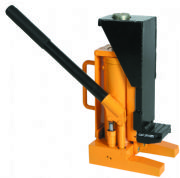
Lifting Jacks are idea for lifting heavy machinery or other bulky objects that are beyond our strength, some items may have a particularly low entry point where the gap for a Lifting Jack is minimal, maybe only a few centimetres, this job calls for a Lifting Jack designed particularly for low entry; the Toe Jack.

Industrial Toe Jack

Industrial Toe Jack

The Toe Jack is operated in a very similar way as the bottle jack and many other designs, the toe is placed under the load, the jack is then raised by pumping hydraulic pressure in to the Jack’s cylinder, which just like a Bottle Jack, raises the toe and lifts the load. The Toe Jack can then be lowered safely by turning the pump handle which gently releases the pressure in the Toe Jack and lowers the load into place.

Toe Jacks are usually used in combination with Machine Skates or Pallet Trucks to lift and shift bulky, heavy items.

How Do Machine Skates Work?

Machine Skates or sometimes referred to as Load Moving Skates are very easy to operate, they work by distributing the weight of the load up to 100 Tonnes over the surface of the skate, underneath the skates surface there are specially engineered castors or ball bearings that allow the skate to move and with some models, turn.

Most people use Toe Jacks or a Roller Crow Bar to lift the load or machine enough to slide a skate into place. Once the skate is in place the Jack or Crow Bar is lowered in order to release the load on to the skate for ease of transport.

Image

Most loads require three skates, two rear skates that connect via a bar to ensure they remain in line with each other and one front steerable skate which includes special steerable wheels to enable the load to travel around corners and be more manoeuvrable.

Machine Skates are used in a variety of other load moving applications such as for loading containers, machine movers can also move pallets and pallet boxes that are too heavy for standard pallet trucks!

Engine Cranes- How Do They Work?

Most commonly used in the automotive industry Engine Cranes were designed to lift, transport and lower engines with a hydraulic boom while being supported by a set of sturdy legs that feature wheels fitted for ease of transport once the engine had been removed from the bay.

Firstly the engine should be freed from any securing bolts and screws, then it should be rigged up using an engine sling, the crane can then be brought in with the stand wheeled under the load (under the car) the crane boom can be lowered using the handle that operates the hydraulic ram.

Once lowered the chain sling should be connected to the crane hook, the engine can now be raised using the handle that operates the hydraulic ram, pumping the handle raises the load, once clear of the engine bay the load can be transported and worked on.

For safety reasons the crane boom can only operate in an vertical operation, this is why the sturdy legs are positioned under the load to prevent the Engine Crane from tipping over when lifting or transporting.

Ratchet Load Binders

Ratchet load binders are used to tie down and secure large loads usually on the back of a lorry or flat bed, load binders are used in conjunction with specially rated lashing chains, the binder attaches to both ends of the chain and the user then operates the ratchet lever in order to tighten the chain and secure the load.

To release the load the ratchet pawl is pressed and the ratchet is then operated in the same way as tightening in order to release the load.

Yale RLSP Ratchet Load Binder

Chains and binders are often used to secure diggers, tractors, large machinery and steelwork as these items can be secured without damage from chains. Binders can be purchased in two formats- with parallel hooks or clevis hooks to suit your application.

Lifting equipment store supply a complete range of ratchet load binders and lashing chains along with lots of accessories to complement such as weld on hooks and lashing points.

Lifting Shackles Types And Varieties

Lifting shackles are designed to provide a closed connection of two components for lifting, pulling and loads as well as connecting components together in rigs. This is usually up to 1,200 Tonnes.

Shackles are manufactured in several different types and sizes, here are a few examples:

Dee Shackles- a ‘D’ shaped shackle featured a slim design with smooth bow and can be purchased with or without a safety locking nut to secure the screw pin in place to prevent tampering or any accidental movement. Options include extended long Dee Shackles as well as many sizes and capacities.

Stainless Steel Dee Shackle

Stainless Steel Dee Shackle

Bow Shackles- the same principle featuring a wider bow to provide extra flexibility with increased surface area on accessories such as slings. Also available in an array of different sizes.

Stainless Steel Bow Shackle

Stainless Steel Bow Shackle

Budget Economy Shackles- these are still manufactured to the correct safety standards as well as being certified to the working load limit as purchased. Economy shackles are cost effective and ideal for non aggressive use.

Premium Brand Shackles such as Green Pin lifting shackles are manufactured from the best quality materials and feature the signature green screw pin. Ideal for more intense work and long term use such as the hire industry.

Stainless Steel Shackles are perfectly suited to outdoor applications where the environment is particularly corrosive such as offshore where sea salt quickly corrodes unprotected material.

There are so many types of Lifting Shackle on today’s market to suit nearly every shackling requirement that could engrave planet earth! There are even Lifting Shackles designed for the theatre industry, coated in a black finish to prevent reflection of light in order to remain subtle.

Pallet Trucks- Making Life Easier

Hand operated or electric Pallet Trucks are perfect affordable handling solutions designed to make life easier by enabling you to lift and shift palletised loads up to 5 Tonnes.

Hand Pallet Trucks are operated by a steering lever that incorporates a release handle, the lever if pumped raises the truck forks in order to lift the load, pulling on the release handle slowly lowers the load. The truck is designed to be driven under a pallet and operated as above, the pallet can easily be pushed or pulled by hand once raised off the ground.

Manual trucks are ideal for transporting pallets around warehouses and for unloading loads from lorries with tail lifts. Before the new 2013 anti-dumping laws that raised taxes on Pallet Trucks up to almost 50% this type of truck could be considered disposable starting at prices little over £100 online, sadly this is no longer the case.

Electric Motorised Pallet Trucks are operated with ease featuring electrically assisted travel and steering operated from a handle similar to a hand pallet truck. These are often used to transport heavier loads or used when operation is intense so it becomes important to make things easier for workers as this often makes them more productive in the warehouse. Electric models are battery operated with a long battery life, most people use the trucks in the day and charge them overnight.

When used outside in the British summer (and obviously winter) pallet trucks can start to rust, for that there are a variety of corrosion resistant galvanised pallet trucks and for the food industry; Stainless Steel models are available as food can often be heavy to transport in bulk, supermarkets often used pallet trucks to unload pallets of meat and vegetables to save time and make life easier! A small addition goes a long way.